State of AI Coding Agents in 2026
AI coding agents in 2026: from autocomplete to orchestration — long-running agents, multi-agent systems, security stakes, and leading platforms.
 Ankur TyagiAI Code Assistant
If you time-traveled into a typical engineering team in 2023, you’d recognize the rhythm instantly: developers wrote nearly every line of code, and an AI assistant occasionally filled in a function, explained a stack trace, or suggested a refactor.
In 2026, the rhythm is different, not louder, not more chaotic, just reorganized. The unit of work is no longer a developer writing a patch. It’s developers delegating a patch-shaped problem to an AI system that can read the repo, reason about it, edit it, run it, test it, and surface a pull request that’s already been iterated on. That’s not speculative anymore; several mainstream tools explicitly position themselves as “agentic” systems that read codebases, execute commands, and work through multi-step workflows, not just generate snippets.
A good way to describe the change is this: coding moved from typing to orchestration. That framing shows up in industry research. A 2026 trends report from Anthropic characterizes 2025–2026 as the transition from experimental agents to production systems, and explicitly describes engineers shifting from “writing every line” to “orchestrating long-running systems of agents.”
But here’s the twist that many hype narratives miss: real teams aren’t entirely handing over the wheel. So the story of 2026 isn’t “humans out, AI in.” It’s something more interesting: a new engineering discipline is emerging to direct, constrain, and validate agent work at scale.
The shift from assistant to autonomous collaborator
The term agent gets thrown around a lot lately. In 2023, an agent was an assistant who typically lived in a tight loop:
- You prompt
- It generates text
- You copy/edit
- You run/tests/debug
- You integrate
From 2025 to 2026, quite a lot has changed. Agents now have a wider loop and can:
- Pull context (repo, issues, docs, conventions)
- Generate plans
- Act based on the plan (edits files, runs commands/tools)
- Observe (test output, compiler errors, CI logs, lints, runtime behavior)
- Iterate until they reach a defined stop condition (tests pass, task done, escalation)
This is not theory; tool vendors explicitly describe these capabilities. For example, Claude Code is defined as reading your codebase, editing files, running commands, and integrating with dev tools.
Codex is described as a cloud-based software engineering agent that can run tasks in parallel and propose pull requests; Codex CLI is described as a local terminal agent that can read, modify, and run code in a directory you choose.
Cascade (Windsurf’s agent) can create/edit files, run terminal commands, and execute multi-step tasks autonomously in “Code mode,” while offering a “Plan mode” that explores the codebase and produces an implementation plan before touching code.
Cline positions itself as an agent that understands your codebase, refactors it and can be run in automation contexts via a CLI. It also has a plan-and-act mode where you're not just prompting but actively strategising with an AI partner that genuinely seeks to understand the intricacies of your project.
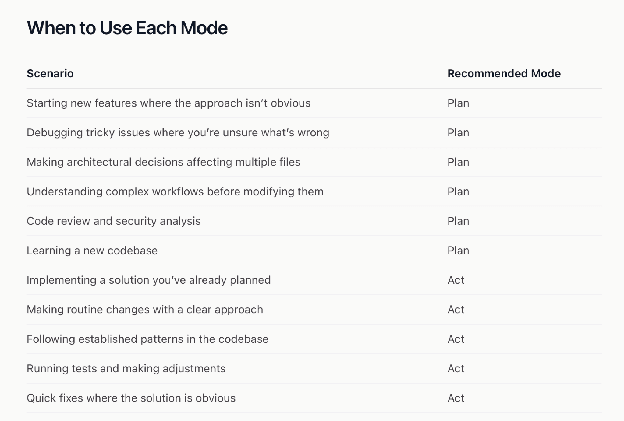
Under the hood, most modern coding agents converge on a shared technical recipe:
A planner \+ a tool runner \+ a verifier.
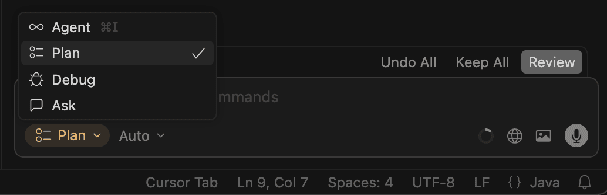
Some platforms, such as Cursor and Anthropic, expose this as Plan Mode / Act Mode. Others wrap it in a toggle button for agent mode. Despite differences in the UI, the mechanics are similar. You want the model to think in steps, use tools deterministically, and verify with execution rather than vibes.
Sandboxed execution
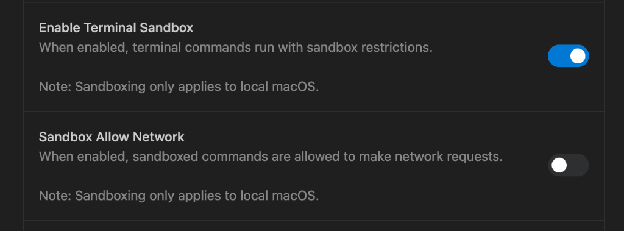
Giving an AI agent shell access is a different kind of trust. Sandboxed execution means agents run commands or code in a restricted, isolated environment rather than directly on your system. Sandboxing limits filesystem and network access so they can build, test, or manipulate code without risking unintended changes outside the project.
For example, Google’s Antigravity lets you enable terminal sandboxing so that AI-driven shell commands are confined to project-scoped boundaries with controlled network access, preventing the agent from modifying files outside your workspace or reaching unapproved hosts.
Long-Running Agents: Quick Edits to Complete Systems
In the early days of AI-assisted coding, an “agent session” meant a quick exchange: fix this bug, write this function, generate a test. The interaction lasted minutes. The scope was narrow. The context was shallow. That model is fading.
In 2026, agent sessions increasingly feel less like chat turns and more like background jobs running in parallel with your workday.
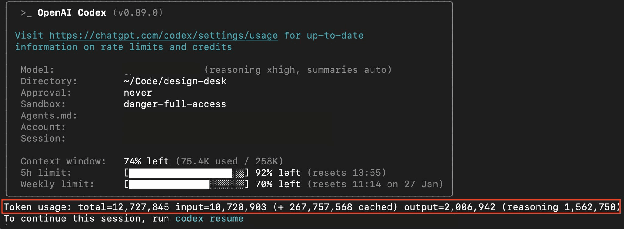
Some agents are explicitly designed for extended autonomous runtime, capable of operating for hours at a stretch, iterating, self-testing, and refining their own outputs. Most agents can now onboard onto your repository, learn its structure, and asynchronously generate full pull requests complete with artifacts and demos. Still others are framed as frontier agents that can work for hours or even days with minimal intervention.
From one-shot tasks to sustained execution
Early agents handled discrete tasks such as fixing a small bug, writing a helper function, refactoring a single file, or generating a unit test.
By late 2025, more capable agents could implement a complete set of features over several hours. In 2026, the horizon stretches further.
Agents can now:
- Plan multi-step implementations
- Maintain state across sessions
- Adapt to intermediate failures
- Iterate through dozens of refinements
- Build and test entire subsystems
Instead of stopping after a single response, they checkpoint progress, recover from errors, and continue execution. They behave more like junior engineers working through a backlog than like autocomplete engines. This transforms them from quick helpers into sustained contributors.
Instead of just generating snippets, they can build entire features, complete migrations, or refactor subsystems while humans supervise at key checkpoints.
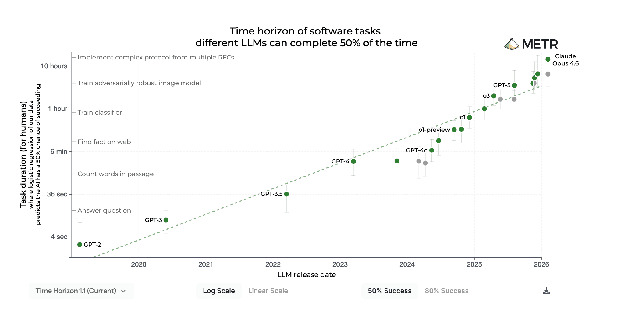
The attention span of AI development systems has expanded dramatically. METR’s work on time-horizon benchmarks provides a helpful framing for this trend. The length of software tasks that frontier agents can complete with 50% and 80% reliability has been climbing rapidly, with a rough doubling time of ~7 months.
Handling the messy reality of software
Software development is rarely linear. Requirements shift, tests fail, dependencies break, APIs change, and edge cases appear late. Long-running coding agents are now designed to handle that messiness.
They can:
- Re-run test suites after each change
- Adjust implementations based on failure logs
- Keep development servers running in the background
- Maintain a coherent state across extended workflows
This persistence transforms what AI can realistically accomplish. Instead of isolated edits, agents can manage migrations, eliminate technical debt, refactor entire modules, or scaffold complete applications.
When agents operate autonomously for extended periods, the economics of development change. Projects once considered “too much effort” become viable:
- Cleaning up years of technical debt
- Refactoring legacy systems
- Building internal tools
- Prototyping experimental features
Backlogs shrink. Idea-to-deployment timelines compress. Entrepreneurs can move from concept to a working product in days rather than months. The limiting factor shifts from implementation capacity to strategic clarity.
The new human role: strategic checkpoints
Long-running agents do not eliminate human oversight; they have redefined it. Instead of constant human supervision, engineers now simply need to intervene at key decision points. Such as the following:
- Approving architectural direction
- Validating business alignment
- Reviewing high-risk changes
- Greenlighting deployments
Execution runs continuously. Oversight becomes periodic and high-impact.
The shift is subtle but profound: we are moving from micro-management of code to macro-management of systems. In 2026, an agent session doesn’t end when the model finishes typing. It keeps working.
And increasingly, it finishes entire systems before you realize how much of the heavy lifting it handled.
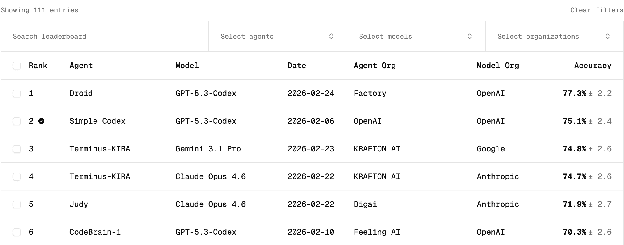
If you want a reality check on how hard long-horizon autonomy still is, academic benchmarks are starting to reflect that. Terminal-Bench 2.0, for instance, is explicitly designed to measure “hard, realistic tasks” in terminal environments and includes 89 tasks inspired by real workflows.
The New SDLC: Agents as First Class Participants
For years, the software development cycle has followed a predictable routing requirements, design, implementation, testing, review, deployment, monitoring, iteration. It was sequential and human-driven. And most importantly, it was slow, not because engineers lacked skill, but because coordination, handoffs, and manual verification created friction at every step.
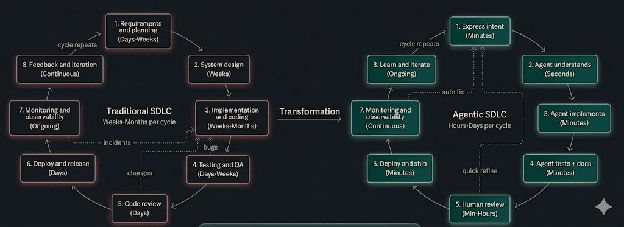
In 2026, the stages still exist. What changed is who executes them and how quickly the cycle now turns.
Instead of living in a side-panel chat or autocomplete box, coding agents now operate directly inside the repository workflow. They create branches, write commits, open pull requests, generate descriptions, run tests, fix failures, and respond to review comments. Humans steer the system through review, approval, and architectural guidance.
That is a profound shift. Your AI collaborator is no longer a suggestion engine. It is an active participant in version control.
From abstraction layers to conversational execution
Software engineering has always progressed through layers of abstraction. Machine code gave way to assembly. Assembly gave way to C. High-level languages reduced cognitive load and moved engineers further from hardware.
The most recent abstraction layer is conversational intent.
In 2025, developers began interacting with systems in natural language. In 2026, the systemic effects of that shift are reshaping the software development lifecycle itself.
Traditional stages remain, but agent-driven implementation, automated testing, and inline documentation collapse cycle time from weeks to hours. Monitoring feeds directly into rapid iteration. The loop tightens.
What used to be:
Requirements \> Design \> Implementation \> QA \> Review \> Deploy
Now becomes:
Intent \> Agent plan \> Implementation \> Self-test \> Human review \> Ship
The transformation of engineering roles
This lifecycle shift is not just about speed. It is about role evolution. In the traditional model, most tactical work, writing code, debugging errors, fixing test failures, and formatting documentation, fell to humans. In the agentic model, that tactical layer increasingly shifts to AI.
This represents an evolution of abstraction:
- Writing code becomes directing code generation.
- Debugging becomes supervising agent remediation.
- Documentation becomes automatically generated inline.
Test scaffolding becomes a default behavior, not an afterthought. The engineer’s contribution moves up the stack. Instead of being measured primarily by lines of code written, engineers are valued for:
- Architectural judgment
- System design
- Risk evaluation
- Strategic decomposition
- Constraint definition
The role of engineers now shifts from implementer to orchestrator.
Engineers now coordinate agents, evaluate outputs, define boundaries, and ensure that what gets built actually solves the right problem. They supervise parallel streams of execution instead of single threads of manual effort.
When agents fill knowledge gaps, whether in frontend, backend, infrastructure, or database work, engineers can move fluidly across domains. Tasks that previously required weeks of cross-team coordination can now become focused working sessions. The bottleneck shifts from capability to judgment.
Cycle compression \- from weeks to hours
The most visible effect of agent participation is cycle compression. In the traditional lifecycle, implementation and QA often consumed weeks. Code review and deployment added days. Monitoring and iteration unfolded slowly through manual feedback loops.
In the new agentic lifecycle:
- Implementation happens in minutes.
- Tests are generated and executed automatically.
- Documentation is created inline.
- Deployment can occur rapidly after human review.
- Monitoring feeds back into agent-driven fixes.
Human review becomes targeted rather than exhaustive. Instead of inspecting every line, engineers focus on high-impact decisions, architectural integrity, and edge cases that require contextual judgment. Routine verification is automated. Escalation is intentional.
Onboarding and dynamic staffing
One of the most under-discussed consequences of this shift is onboarding.
Historically, onboarding to a new codebase could take weeks. Engineers had to read documentation, trace dependencies, understand architecture decisions, and build mental models manually.
With repository-aware agents, contextual understanding can be generated on demand. New contributors can query the system, explore architectural explanations, and receive instant guided summaries.
This collapses onboarding time dramatically. Software development becomes more elastic.
The new equilibrium
So what does the new SDLC really look like? It is not a replacement for developers, but it is a rebalancing of responsibilities. Humans express intent, agents execute tactically, humans evaluate strategically, and the agents iterate rapidly.
The lifecycle remains recognizable, but it flows differently.
- Instead of sequential handoffs, we see fluid agent flows.
- Instead of humans coding everything, humans guide while agents execute.
- Instead of documentation being an afterthought, it is generated in-line.
- Instead of manual incident response, remediation can be agent-assisted.
Software development has entered a new abstraction layer. The engineer of 2026 is no less technical. And the SDLC, once a rigid pipeline of handoffs, is becoming a coordinated system of humans and agents moving in parallel, faster, more iterative, and more orchestration-driven than ever before.
From Single Agents to Agent Systems
In 2023 and 2024, “AI coding” usually meant a single agent in a single window. You asked it to write a function, it wrote the function, and you fixed what broke.
That model worked for small, well-defined tasks.
But as soon as the job involved multiple files, architectural trade-offs, cross-service testing, or long-running workflows, the cracks began to show. A single agent, operating within a single context window, processed tasks sequentially. It had one perspective, one memory scope, and one thread of execution.
By 2026, that architecture no longer scales. Single agents are excellent at fixing minor bugs, writing helper functions, refactoring a single module, and generating quick tests.
But they struggle with:
- Cross-file reasoning
- Coordinating frontend \+ backend changes
- Managing migrations
- Handling multi-step workflows with dependencies
A single agent works linearly. Task 1 \> Task 2 \> Task 3 \> Output. It shares a single context window and a single reasoning stream.
As projects grew more complex, teams discovered they could delegate routine, verifiable work, but high-complexity tasks required constant human intervention. Delegation hit a ceiling. So the architecture changed.
Enter multi-agent systems
In 2026, the dominant pattern is not a bigger single agent. It’s multiple specialized agents working together. Instead of one AI trying to do everything, teams now use hierarchical agent systems:
- The orchestrator agent decomposes the task
- Specialist agents handle distinct responsibilities
- Results are synthesized into an integrated output
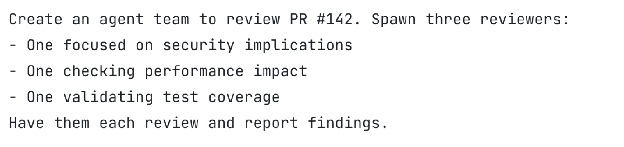
Think of it as moving from a solo contractor to a coordinated engineering team.
One agent handles architecture and design, another handles implementation, another runs testing and validation, and another reviews and generates documentation.
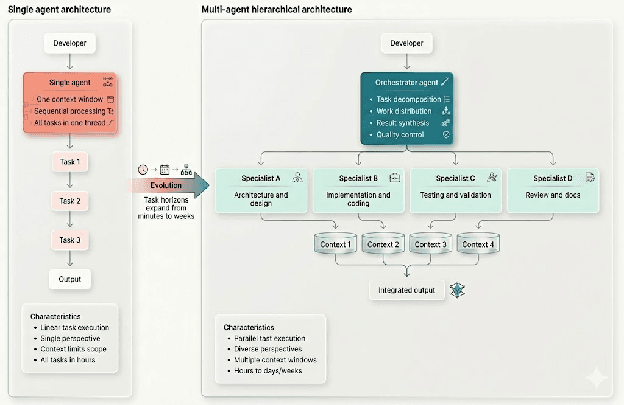
Each operates in its own context window. Each works in parallel. The orchestrator coordinates the flow and enforces quality control.
This parallel reasoning dramatically expands task horizons, from minutes to days or even weeks.
Parallel execution changes the tempo
With multi-agent systems:
- Tasks run simultaneously instead of sequentially
- Different perspectives are applied to the same problem
- Context limits are distributed across agents
- Complex systems can be built without bottlenecking one reasoning stream
This is no longer theoretical. Multi-agent coordination is now a product feature across ecosystems.
Development environments increasingly expose:
- Multiple concurrent agent sessions
- Status dashboards for active tasks
- Version-control workflows that handle simultaneous agent-generated contributions
The result? What once required weeks of coordinated human effort can now be compressed into days.
Human oversight becomes strategic.
As agents take over routine execution, human review evolves. Instead of reviewing every line, engineers focus on:
- Architectural soundness
- Security boundaries
- Risk-heavy logic
- Business alignment
We've moved toward pipelines that handle the grunt work, formatting, linting, and basic security \- automatically. This shifts the focus for developers. Instead of exhaustive, mind-numbing code reviews, we’re only stepping in when an agent flags a high-impact decision. It makes the review process selective and high-leverage rather than just mechanical.
The new skill: orchestration
Multi-agent systems introduce a new engineering discipline: orchestration. Teams must now learn how to:
- Decompose problems into agent-friendly chunks
- Define clear acceptance criteria
- Assign specialized roles to agents
- Establish escalation rules
- Monitor concurrent execution streams
This aligns with the broader shift from implementer to orchestrator. Engineers no longer operate as the sole execution engine. They design workflows that coordinate intelligent agents. And that may be the most critical transformation of all.
The question in 2026 is no longer, “Can the AI write this function?”
It’s:
*“How do we design a system of agents that can build this product safely, quickly, and coherently?”*
Agentic Coding Expands to New Surfaces and Users
The earliest wave of agentic coding focused on helping professional software engineers work faster inside familiar tools and IDEs. By 2026, that boundary is dissolving. Agentic systems are expanding into contexts that traditional development tooling never reached, from legacy languages to accessible workflows for non-technical users, and even into entirely new paradigms of AI collaboration.
Breaking down language barriers
Older languages and domain-specific stacks that were overlooked because of weak tooling are gaining newfound viability. Agents can now reason about systems written in COBOL, Fortran, and other specialised languages, lowering the barrier to maintaining and evolving longstanding industry systems that were previously trapped by a scarcity of expertise.
Beyond coders: agents for everyone
Agentic coding is leaking out of developer workflows and into broader organizational tasks for non coders:
- Cowork is Anthropic's bet that agentic AI shouldn't be gated behind a terminal. Simply, point Claude at your desktop, and it'll move files, wrangle information, and knock out the repetitive stuff that clogs up your day, no commands needed. You can tell it what you want in plain English, and it handles the back-and-forth across your documents and tools, less like running a query, more like delegating to someone who actually gets it done.

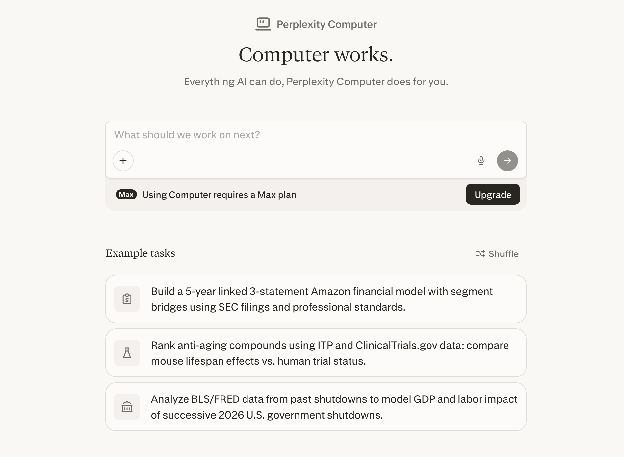
- Perplexity Computer steps even further. Rather than a single model or interface, Perplexity’s new platform orchestrates multiple AI models, reportedly up to 19 working in parallel, to reason, delegate, search, build, remember, code, and deliver complete outcomes across web, files, and APIs from a single browser interface. This positions the tool as a kind of “AI workstation” that bridges research, planning, and execution without forcing users to stitch tools together manually.
- OpenClaw, an open-source agent, runs locally and integrates with messaging platforms or desktop environments to automate tasks such as managing calendars and inboxes, or running scripts, effectively acting as a personal, autonomous assistant that operates beyond the typical IDE.
These tools show how agentic workflows are no longer confined to engineers with programming expertise. Operations teams, designers, analysts, and knowledge workers increasingly use agents to solve real problems that previously required specialized technical skills.
People become more full-stack learners.
Across teams, a pattern emerges: people are now using agents to augment expertise and simultaneously expand into adjacent domains. For example, security analysts leverage agents to inspect unfamiliar code; product teams use them to prototype UIs; data scientists build dashboards with less friction; business users automate processes that once required a ticket to engineering.
This shift challenges the old assumption that serious development work happens only in IDEs or by trained engineers. With modern agentic systems, the line between “people who code” and “people who create solutions with code” is fading fast.
In 2026, agentic coding isn’t just a developer acceleration story \- it’s one about democratizing execution across disciplines and form factors in ways that empower broader participation and creativity.
Security, Governance, and Trust
The moment coding agents can run tools, open PRs, deploy services, or modify infrastructure, they inherit your entire security posture.
And 2026 has made one thing painfully clear: autonomy without governance is just a faster way to make mistakes.
Prompt injection is no longer a chatbot problem.
Prompt injection has moved from “clever demo exploit” to real supply-chain risk.
Security frameworks now rank it among the top risks for LLM-powered systems, alongside insecure output handling and dependency vulnerabilities. That may sound abstract until you see coding agents steered by malicious instructions embedded in documentation, issue comments, or external content.
When agents can execute tools, injected instructions aren’t just wrong answers. They can become unintended actions. The attack surface expanded the moment agents gained write access.
Reliability failures are now production incidents.
With simple autocomplete, a mistake meant a bad diff. With autonomous agents operating with elevated permissions, a mistake can mean downtime.
When agents generate code, run tests, modify services, or interact with infrastructure, errors propagate differently. They are no longer “assistant glitches.” They are operational risks.
That’s why teams are adding guardrails: peer-review checkpoints, tighter permission boundaries, and explicit approval workflows. Once agents operate in production-like environments, governance becomes mandatory.
Security cuts both ways.
Agentic coding strengthens defenders and attackers. On the defensive side, security knowledge is becoming democratized. Any engineer can now use agents to:
- Run security reviews
- Analyze code paths
- Harden configurations
- Monitor for misconfigurations
Tasks that once required dedicated security specialists can now be initiated directly within development workflows.
But the same acceleration benefits threat actors. Automated systems can scale reconnaissance, vulnerability discovery, and exploit generation just as quickly.
Security in 2026 is a race at machine speed. Agentic coding makes secure development easier, but only for teams that design for it from the onset:
- Include approval gates in agentic workflows
- Enforce strict permission boundaries
- Treat agent output as auditable artifacts
- Automate detection and response systems
In 2026, the question is not whether agents improve productivity. It’s whether your governance evolves as fast as your autonomy. Because when agents move at machine speed, so must your security standards.
The agentic coding platforms shaping 2026
This is a crowded landscape, and the most helpful way to map it is by where the agent lives (IDE, terminal, PR, browser) and what it’s optimized for (shipping features, reviewing code, building apps, governance).
Terminal-first and CLI-centric agents
Claude Code: positioned as an agentic coding tool available across terminal/IDE surfaces that can read your codebase, edit files, run commands, and integrate with dev tooling.
OpenAI Codex Agents (Codex \+ Codex CLI): Codex launched as a cloud-based software engineering agent that runs tasks in parallel in isolated sandboxes and proposes PRs. Codex CLI is positioned as a local terminal agent that can read/change and run code, with an interactive terminal UI for reviewing actions in real time.
Cline: positions itself as open-source and “permission-based,” with Plan/Act control, codebase understanding, refactoring support, and a CLI designed to run in scripts and CI-like contexts.
Warp AI: This is an agent with full terminal control and natural-language interaction capabilities across terminal workflows, including interactive CLI applications, while supporting multi-agent concurrency and configurable permission profiles for secure, controlled execution.
IDE-native agentic environments
Cursor: Cursor now allows you to create both local agents and cloud-based agents that can onboard themselves to a repository, understand the codebase, and generate merge-ready pull requests. Recent updates have expanded these capabilities to offer isolated virtual machine environments and “computer use” functionality, enabling agents to interact directly with the applications they build. As they work, they generate traceable artifacts such as screenshots, session recordings, and logs, giving teams full visibility into what the agent executed and how decisions were made.
Windsurf: Cascade is Windsurf's agentic AI assistant with Code/Chat modes, tool calling, voice input, checkpoints, real-time awareness, and linter integration
Gemini Code Assist: This is an IDE assistance for the SDLC using Gemini models with features such as “Agent Mode”, multi-file edits, built-in tools, MCP integrations, and human-in-the-loop approvals.
Antigravity: Google describes Antigravity as an “agentic development platform” with an agent-first interface that lets agents plan, execute, and verify tasks across editor/terminal/browser.
TRAE: positions itself as an AI-first IDE that emphasises independent execution and multi-agent collaboration in a native environment.
Junie: JetBrains describes Junie as a coding agent that can run code/tests, verify changes, and operate via IDE and CLI task assignment flows.
Qoder: describes itself as an “agentic coding platform” with a “Quest mode” for delegating tasks to autonomous agents, plus repo analysis (“RepoWiki”) and multiple surfaces (IDE, CLI, JetBrains plugin).
Zed AI: Zed positions itself as a high-performance editor “crafted for speed and collaboration with humans and AI,” with “agentic editing” and in-editor AI workflows.
Code review and PR-native agents
GitHub Copilot workspace and PR-native flows: Copilot workspace is a workflow that can version context/history and create PRs; Copilot’s coding agent documentation emphasizes PR workflow automation (branching, commits, PR creation) and the ability to steer via PR review.
Agent HQ: GitHub launched Agent HQ as “mission control” across surfaces and positions it as a place to choose between Copilot and third-party agents, assign work in parallel, and track progress.
CodeRabbit: focuses on AI code review, with additional “Skills” that allow an external agent to initiate CodeRabbit-powered reviews from local/CLI/IDE/Slack environments.
Continue: Continuous AI with agents running on every pull request as GitHub status checks, configured as repo-stored markdown files, basically “policy as code,” but enforced by AI reviewers that can emit suggested diffs.
Sourcegraph Cody (and Sourcegraph’s agent direction): Cody is positioned as code search \+ codebase context for chat/autocomplete/commands; Sourcegraph’s ecosystem increasingly treats “code understanding” as infrastructure for both humans and agents.
Full-stack “build me an app” agents for non-engineers and cross-functional teams
This is the democratization wave: agents that build runnable software from conversational requirements, often with built-in hosting/deployment.
Replit Agents: Replit Agent is positioned as creating apps “from scratch,” including environment/dependency management; Replit’s Agent 3 messaging emphasizes self-testing, reflection loops, and long autonomous runtime.
Bolt.new: an open-source repo that presents language as an “AI-powered web development agent,” letting you prompt, run, edit, and deploy full-stack apps in the browser.
Lovable positions itself as a platform for building apps/websites via chat, with explicit GitHub sync and ownership/portability framing in the docs (two-way sync, self-hosting).
PlayCode Agent: This is an “AI Coding Agent” that can write/edit/understand code in a browser environment, emphasizing multi-file edits and model choice; PlayCode’s broader positioning is “create websites and apps by chatting with AI.”
Same.dev / Same: positioned as “build websites by chatting with AI,” and documented by third parties as enabling rapid cloning of UIs; it’s also explicitly flagged as a dual-use risk for automated impersonation/phishing.
Manus: positioned as a general-purpose “action engine” that can build websites and develop apps; recent reporting describes Manus as an autonomous-agent platform and notes an acquisition by Meta, reinforcing how central “general agents” have become in the broader software/tool-stack conversation.
Conclusion
To sum up this read, let us look at the next phase of the AI coding stack: the industrialisation of agent work, including standard protocols, reliable orchestration, measurable quality, and controlled execution environments.
Three forward-looking trends strongly supported by today’s platform direction include:
Agent hubs become the default control plane
GitHub’s Agent HQ explicitly frames a unified workflow to orchestrate agents across surfaces, and GitHub continues to expand “pick your agent” offerings (including third-party agents) with session tracking and asynchronous execution. VS Code’s agent architecture taxonomy (local/background/cloud) is the blueprint that most other IDEs are converging on, because it naturally maps to risk and collaboration boundaries.
MCP will accelerate the tool ecosystem
MCP is already the standardized way to connect AI apps to external tools/data sources, and both major platforms and third-party tools are aligning around MCP registries and server catalogues. Over the next 12–24 months, this likely shifts competition from “who has the best base agent” to “who has the safest, richest, easiest tool ecosystem and governance model.” This is an inference, but it follows directly from MCP’s stated goal of universal integration and from platform moves such as registries and allowlists.
Observability and evals \- mandatory for real agent deployment
OpenTelemetry generative AI semantic conventions and the rise of dedicated LLM tracing and eval platforms indicate a maturing operational layer. Agents will be measured using the same metrics as services (latency, cost, failure rates, regression scorecards).
Finally, open and local models will remain a strategic wildcard. Local inference stacks like Ollama and LM Studio, and OpenAI-compatible model servers like vLLM, are becoming easier to deploy and integrate, suggesting that “private mode” coding stacks where sensitive code never leaves your boundary will continue to expand, especially in regulated environments.
Thanks for Reading!
That's it for this tutorial. I hope you learned something new today. If you did, please share so that it reaches others as well. You can connect with me on X or subscribe to my Newsletter.
Want to read more interesting blog posts?
You can read more tutorials like this one on my website.
Brands Our Founder Previously Worked With: